One of the most significant underwater discoveries made in Sardinian waters is that of a Roman-age wreck identified in the stretch of sea between the coast of Sinis and Mal di Ventre Island. In the area, which must have been quite dangerous for navigation due to the strong mistral wind, there are other ancient wrecks, but the most important, especially due to the nature of the cargo, is certainly the one which from 1989 to 1996 was the subject of numerous excavation campaigns by the Archaeological Superintendence of Cagliari and Oristano.
The ship, located at a depth of about 30 m, 6 miles from the coast and just over 1 mile south-east of the island, owes its extraordinary importance to its cargo, which consists entirely of lead ingots — the only case so far documented in the Mediterranean. Of the hull, with assumed dimensions of 36 x 12 m, only the central portion of the keel is preserved, over an area of about 10 m², a part which after the sinking of the ship was protected by the cargo. The lack, at the time of the excavation, of sufficient financial resources for the treatment and conservation of the wooden remains suggested the wisdom of leaving the hull in place and postponing its recovery to a more favourable time.
The cargo consists of about a thousand ingots, all with a trapezoidal section, with a slightly bulging upper back and weighing about 33 kg. Many of these were still aligned and stacked in their original position because the sinking of the ship took place slowly and without the cargo capsizing. The ingots, in good state of preservation, bear an epigraphic cartouche with the name of the producers; most of the examples refer to the Pontilieni brothers Caius and Marcus, but the stamps of Quintus Appius and Lucius Carulius Hispalus are also well documented. Attestations of other producers such as Planius Russinus, Gnaeus Atellius, Caius Utius, Marcus or Lucius Apinarius and Pilon are instead occasional.
Near the wreck four large lead anchors were also recovered, with stocks decorated with a dolphin and four opposing astragals in relief, as well as three small anchors, two sounding leads, lead pipes, one of which referable to the bilge pump, some volcanic stone millstones, a small number of transport amphorae, sparse common pottery, an oil lamp, an iron dagger, about 200 lead bullets and a coin. A large iron anchor located in the centre of the hull was left in place. It is likely that the recovered amphorae, of no great number, contained the on-board food supplies; in one of them numerous fish bones with bony parts of the head and tail were found.
Nails were very abundant, partly referring to the structure of the hull, others interpreted as on-board reserves for any repairs; 12 large nails, some about 80 cm long, were also identified still embedded in the keel.
In collaboration with the National Institute of Nuclear Physics and the CNR of Pisa, numerous analyses were carried out on the ingots, which demonstrated the exceptional purity of the metal, traceable to the mining areas of the Sierra de Cartagena, in Spain, the area from which the ship probably came; the final destination of the ship remains uncertain. From a chronological point of view, the overall examination of the materials has made it possible to date the sinking between 89 and the middle of the 1st century BC.
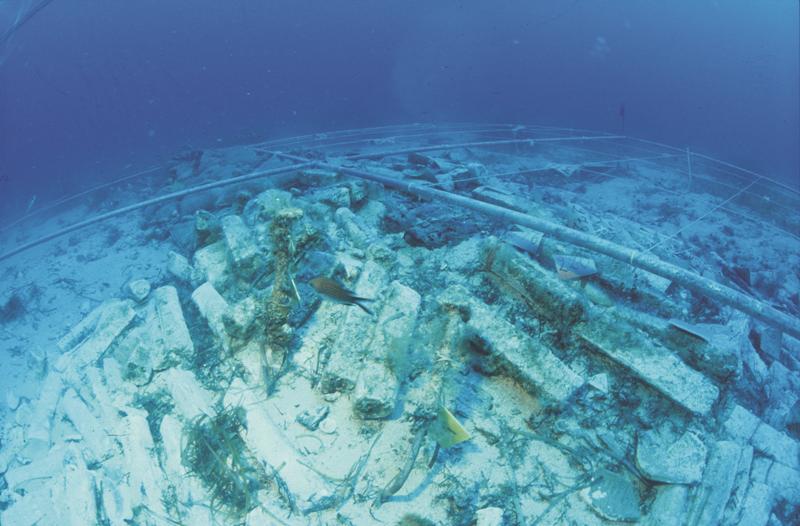
The Mal di Ventre wreck with its cargo of ingots (image taken from “I quaderni a.m.p 02: storia e archeologia”, p. 41)