The city of Tharros, located at the southern end of the Sinis Peninsula, was founded at the end of the 8th or in the 7th century BC by Phoenician peoples in an area already frequented in the Nuragic age. On one of the three hills on which the city stands, the northernmost, known as Murru Mannu (in Sardinian “great snout”), an important protohistoric village (Middle to Late Bronze Age) is still visible today, which must have already been abandoned at the time of the arrival of the Phoenicians. The remains of a Nuragic monument have been recognised at the base of the Spanish tower on the hill of S. Giovanni; two other nuraghi are located on Capo S. Marco, one, called Baboe Cabitza, on the highest part of the hill, the other near the inlet of Sa Naedda.
The arrival of the Phoenicians and the foundation of the city coincide with a moment of extraordinary colonial activity by the Levantine peoples in the central-western Mediterranean. We do not know, however, the exact location of the Phoenician settlement, which certainly cannot have been monumental in character, while we have funerary and votive evidence. From this period, two necropolises located at a distance of a few kilometres from each other are in simultaneous use: the better-known one is on Capo S. Marco, the other, never systematically investigated, is now within the modern village of S. Giovanni di Sinis. The reason for this duality is still being questioned, not excluding the possibility of two nearby inhabited centres. The burials, datable from the last quarter of the 7th century BC, are in most cases simple pits dug in the sand or in the outcropping rock in which the cremated remains of the deceased are placed, accompanied by ceramic grave goods and personal objects.
As regards the sacred sphere, the oldest materials found in the tofet can be mentioned: the typical Phoenician-Punic open-air sanctuary, surrounded by a sacred enclosure and characterised by the presence of urns containing the cremated remains of children who died at a very young age and of sacrificed animals, and of stelae, true stone signs bearing the symbol or image of the divinity placed on a throne or inside a small temple. The nature of the tofet sanctuary is still debated, whether it was a place of sacrifice of children offered to the deity or, more probably, a necropolis intended for stillborn babies or those who died prematurely before having undergone a rite of passage and thus before being received into the community of adults. In the second half of the 6th century BC, a moment of great changes not only in Sardinia due to the prevailing expansionist policy of Carthage, Tharros did not escape the control of the African metropolis. The monumentalisation of the city must be referred to the Punic age; its centre is now found on the eastern side of the hill of S. Giovanni. In the period between the end of the 6th century and 238 BC, the year of the Roman conquest of the island, numerous buildings were constructed, some of which are still partially preserved beneath those of later ages.
First of all, mention should be made of the imposing fortified walls that close the city against possible attacks from land and sea; a complex system, not yet well known in its various articulations, is attested at the northern end of Murru Mannu and from there continues to the top of the hill of S. Giovanni, where, in place of the pre-existing nuraghe, a tower or in any case a fortified structure was built; the walls from there must have continued southwards along a route that is known only in broad outlines, before closing the city to the east.
The tofet, now included within the fortified space, continues its activity, undergoing various rearrangements due also to the saturation of spaces because of the high number of depositions (some thousands of urns and over 300 stelae have been recovered). It should be noted that in the area immediately west of the sanctuary, in the space between it and the walls, an important craftsmen’s quarter specialised in iron working was probably set up at the end of the 5th century BC. Archaeometric investigations carried out on smelting slag and on fragments of the furnaces used for metallurgical activity have shown a high level of technical knowledge on the part of the Tharros craftsmen, who were able to reach very high temperatures.
Some of the most important places of worship of Tharros are to be referred to the Punic age, including the so-called monumental temple or “temple of the Doric semi-columns”, a structure partly carved out of the natural rock bench, partly built with large square blocks. This monument, largely dismantled in ancient times, consisted of a stepped base at the summit of which a small temple or altar must have stood. The decoration carved on three walls is unusual, consisting of fluted semi-columns originally surmounted by Doric semi-capitals and, at the corners, by pilasters with semi-capitals of Aeolian-Cypriot type; ashlars with reliefs of this type, pertinent therefore to the upper part of the base, are reused in a structure of uncertain interpretation present east of it.
The characteristic chamber tombs visible on Capo S. Marco and among the houses of the village of S. Giovanni are to be attributed to the Punic age. These burials, consisting of an entrance room generally provided with a stairway and a very simple burial chamber, hosted the inhumed bodies, laid in a supine position together with rich ceramic grave goods and personal objects, sometimes precious. Most of the very numerous artefacts (ceramics, terracottas, jewellery, amulets, scarabs) which are now kept in the major Sardinian, Italian and foreign museums come precisely from these tombs, recovered during regular and especially clandestine excavations which from at least 1830 have affected the necropolises of Tharros.
Starting from the Roman conquest of the island, which took place in 238 BC, a process of profound change began which was to be completed only in the Roman imperial age. The reorganisation of the fortifications of Murru Mannu is referred to the Republican age; to the pre-existing structures in large sandstone blocks, a refacing in basalt boulders was added, and the raising of a counterscarp wall delimits a wide and deep ditch. As regards religious buildings, the so-called “temple K”, attributed to the 2nd century BC, should be noted. While taking up typically Italic architectural schemes, it preserves some elements of Punic tradition. The reuse in the Roman monumental complex of two blocks bearing some Semitic letters incised on them has led to the hypothesis of the existence of a pre-existing temple, defined for this reason “the temple of the Punic inscriptions”.
In the subsequent imperial age the city was considerably transformed. An impressive urban reorganisation was carried out, providing for the orthogonal organisation of the Murru Mannu quarter; around the 2nd century AD the streets were given a basalt paving and a sewer system was built for the disposal of rainwater. Numerous monumental public buildings were erected, including three thermal complexes, located in the central part of the city, a short distance from each other. These buildings, made of brick and in several cases decorated with polychrome mosaics, were equipped with changing rooms, artificially heated rooms and others where cold baths could be taken. The aqueduct, the remains of which are partly visible along the modern road leading to the excavations, must also be attributed to the imperial age; connected to it is the so-called castellum aquae, a large building located in the centre of the city, at the intersection of the two main streets, the cardo maximus and the decumanus. The structure, almost square in plan, with eight pillars inside delimiting three naves, walls without external openings and traces of hydraulic mortars, is generally interpreted as a deposit for the water brought to Tharros by the aqueduct; in front of it the remains of a monumental fountain have been identified.
The funerary areas appear more extensive than in the previous period: Roman tombs by inhumation and cremation appear along the entire coastal strip between Capo S. Marco and the village of S. Giovanni di Sinis, inside the Murru Mannu ditch, now disused due to the achieved Pax Romana, and in the area between the church of S. Giovanni and the western coast.
Among the numerous tomb types documented, depositions in simple pits, monolithic sarcophagi, “alla cappuccina” tombs (pits lined with opposing roof tiles), inhumations within commercial amphorae (enchytrismoi), cupa tombs (with a semi-cylindrical external marker), cremations in clay or lead urns can be mentioned.
In the early Christian and early medieval ages the main Roman public structures underwent modifications; in particular the baths no. 1 were annexed to a Christian cult complex, also including a hexagonal baptistery with a baldachin and a church building considered by some to be the ecclesia Sancti Marci, known from the sources; the baths no. 2 also changed use, as the presence of Byzantine-age burials suggests. The continuous spoliation of the ancient structures, perpetrated for centuries, has significantly compromised the reconstruction of this late phase in the history of the centre. We know of a slow decline, also due to the Saracen incursions, and of a progressive depopulation, although the episcopal seat remained for a long time in the city. It is only in 1071 that this was transferred to Oristano, which had also become the capital of the Giudicato, decreeing — or rather acknowledging — the end of the ancient centre.
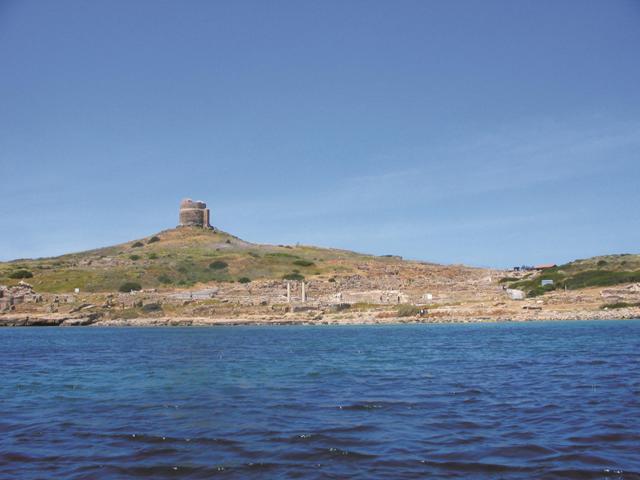
– Tharros seen from the sea
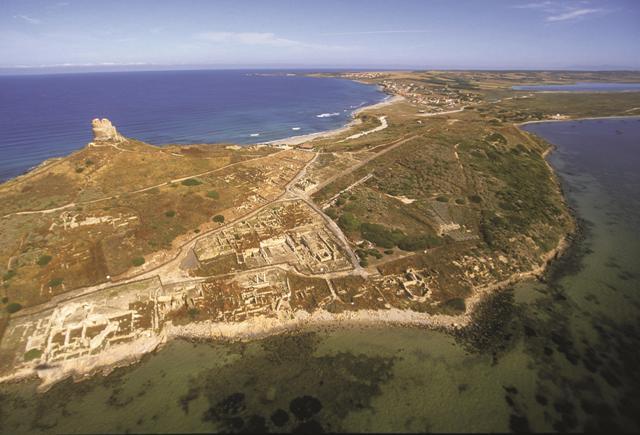
– Aerial view of the archaeological area
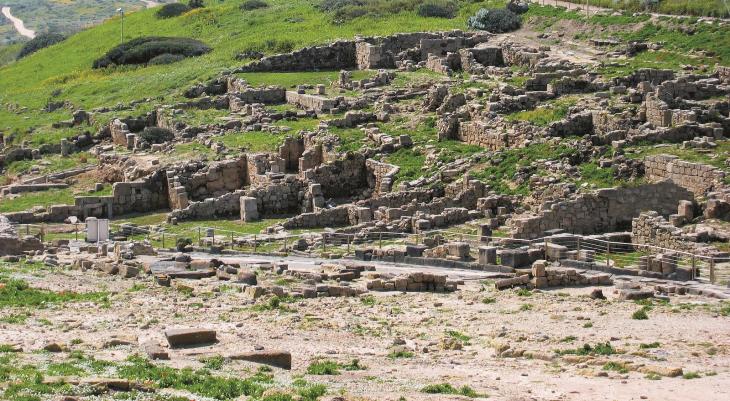
– Detail of the residential quarter on the hill of San Giovanni (images taken from “I quaderni a.m.p 02: storia e archeologia”, p. 31)