Between the 16th and 17th centuries, on the initiative of the Spanish Crown, the towers of S. Giovanni, Torre Vecchia (or of S. Marco) and Torre del Sevo (Turr’e Seu) were built along the coast of the Sinis of Cabras. Like the other Sardinian coastal towers, they were erected to protect the local populations from incursions by pirates and Barbary corsairs from nearby North Africa.
The tower of S. Giovanni, so named for being close to the church of S. Giovanni di Sinis, was built between the end of the 16th and the beginning of the 17th century on top of the hill (50 m a.s.l.) overlooking the archaeological area of Tharros. Of considerable size and with extensive visual command over the Gulf of Oristano and out to the open sea, it was armed with cannons and swivel guns and garrisoned by a unit composed of an alcaide, a gunner and four soldiers. It is supposed that the tower was built on the remains of a single-tower nuraghe and a Punic tower, with stones taken from the ancient city of Tharros; it consists of two superimposed cylindrical bodies with a base diameter of 14 m and a total height of 15 m. The entrance opens at a height of about 8 m above the ground, today reachable by an external staircase built in the 19th century; a large circular hall vaulted with a dome, illuminated from above by a skylight, has on the floor a hatch that allowed access to the cistern for collecting rainwater, while around it are arranged the fireplace and the powder magazine. On the terrace, accessible by an internal staircase, in the second half of the 19th century, when the tower was garrisoned to suppress smuggling, two living quarters were built.
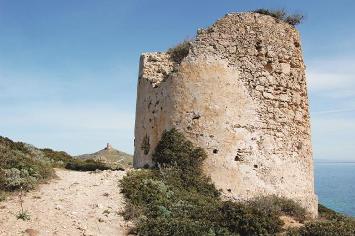
The Torre Vecchia, located along the eastern coast of Capo S. Marco, is built of sandstone ashlars and originally had wall faces plastered with lime mortar; it has a truncated cone shape, base diameter of 7.55 m, top diameter of 7.25 m, with a height of 8.70 m. The tower was accessed directly from the terrace.
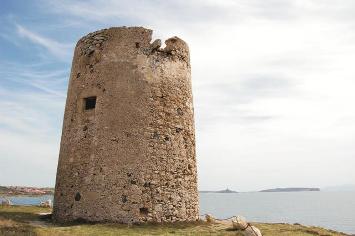
The Torre del Sevo (or Turr’e Seu) stands on a small cliff at 13 m a.s.l. inside the Seu nature oasis. The building has a truncated cone shape, with a base diameter of 7.70 m, a top diameter of 6.70 m and a height of 9.70 m. The entrance, located at 4.20 m above the ground, leads into a domed room. To the right of it is a small room with a window, probably used as the powder magazine, while on the left a stairway leads to the terrace. This is equipped with a parapet with three openings in which the cannons were housed. The tower preserves three of the four corbels; the two facing the sea must have supported a guard sentry-box, the others were used for raising the rope ladder. The structure, made of sandstone blocks, is coated with lime mortar plaster.
Another tower, that of Su Pottu (Turr’e su Pottu), was probably built at the end of the 17th century on the southern shore of the Cabras pond, about 2 km from the village, with the function of guarding and protecting the fishing activities practised in the lagoon basin. The building has a cylindrical shape with a diameter of 7.60 m and a height of 8.20 m. The entrance, at a height of 3.30 m above the ground and currently reachable via a recently built reinforced concrete staircase, leads into a domed room; on the left side of the entrance starts a stairway that leads to the terrace, surrounded by a parapet with three openings for the housing of the cannons.
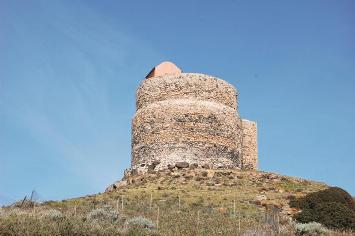
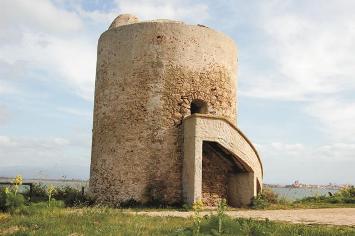
– The tower of San Giovanni di Sinis
– Torre Vecchia
– Turr’e Seu
– The tower of Su Pottu
(images taken from “I quaderni a.m.p 02: storia e archeologia”, p. 57 and 59)